
The company
The client is a global automotive supplier, with operations in more than 20 countries, 150 sites and annual revenue above EUR 9 billion. FY2027 is its first reporting year under the CSRD, and its double materiality assessment (DMA) is subject to limited assurance.
The challenges
A moving regulatory baseline. The European Sustainability Reporting Standards (ESRS) and the definition of materiality were revised while the assessment was under way.
A large and complex group. A long list of more than 100 Impacts, Risks, and Opportunities (IROs), many functions and stakeholders involved, operations and value chains spread across regions.
Interdependencies hard to see. Assurance providers test whether materiality conclusions are consistent across topics. With many IROs assessed by different owners, divergences between related IROs are easy to miss and costly to fix late in the process.
The solutions
1. Starting from the business ecosystem
Disclosures from sector peers and the sustainability requirements of OEM customers were reviewed to identify the matters the market already treats as relevant. The methodology set out how each benchmarking result fed into the IRO long list, so every external input could be traced to a specific IRO.
2. Adapting to the revised standard
When the ESRS changed, the assessment was resized to the new requirements. The existing long list, stakeholder input and scoring were kept and realigned, so the work did not restart from zero.
3. Mapping interdependencies between IROs
IROs were grouped by ESRS topic and linked whenever an IRO affected matters or stakeholders covered by another topic. Circular economy is a typical case: a single IRO can involve resource use, customer requirements and product design at the same time.
A consistency rule was then applied. Any pair of linked IROs with diverging materiality outcomes was flagged and discussed with the relevant function owners, then closed with a documented rationale, either by revising one of the conclusions or by explaining why the divergence was justified. In this assessment the review was carried out on pairs. The same rule extends to larger groups: where three or more linked IROs show mixed outcomes, the group is reviewed as a whole, so that a single discussion covers the shared issue.
The visualisation shows how diverging materiality conclusions were highlighted (examples are illustrative):
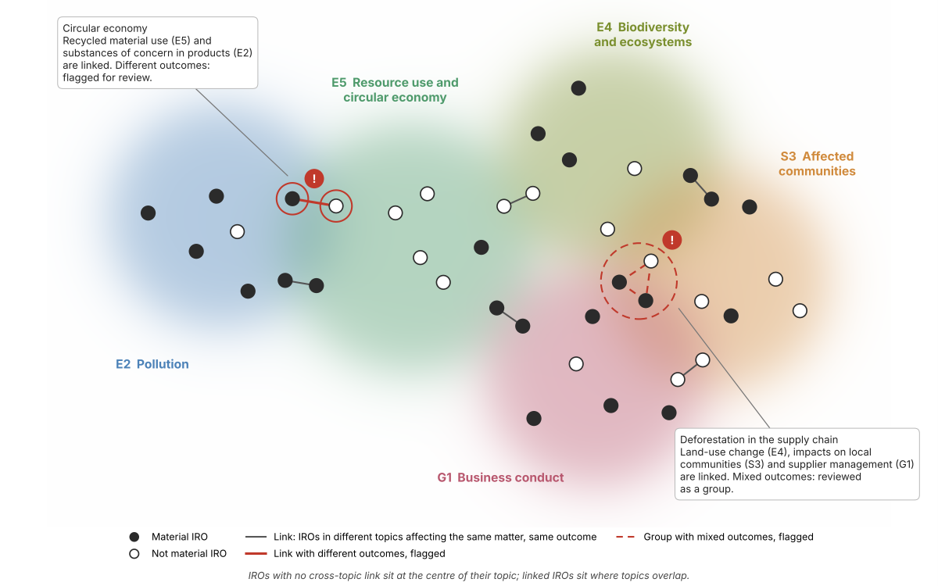
The visualisation shows how diverging materiality conclusions were highlighted (examples are illustrative)
The results
The interdependency analysis requested in the assurance process already existed when the documentation reached the auditors.
Auditor feedback was handled within the existing structure: where a conclusion was revised, the map showed immediately which other IROs to check.
The assurance package required only minor edits.
What other companies can take from this
Consistency built before assurance costs less than consistency rebuilt after it.
Grouping IROs by topic and recording their interdependencies makes the annual DMA update faster, since only the elements that change need to be reassessed.
Benchmarking is most useful when the methodology defines in advance how its results enter the assessment.
How Synestia can help
Double materiality assessments and annual updates
Consistency review of an existing IRO register ahead of assurance
Peer and customer benchmarking of sustainability disclosures