
Sustainability risks are systemic. A drought reduces the yields of growers, raw material prices rise for every company that buys from the same region, and the higher costs can reach consumers and retailers. A new carbon price affects processing plants, transport and packaging suppliers at the same time. When many companies depend on the same resources, the same regions and the same suppliers, a single shock spreads through the whole sector.
A strategy or a target can fall short for reasons that were never in view. A sourcing commitment, a decarbonisation plan or a supply security target may be missed because of a hazard affecting suppliers in another region, a regulation hitting a key input, or a dependency shared with competitors.
Risk assessments and corporate strategies do not capture this well. Risks are usually assessed separately and ranked. The connections between them, and between companies, remain in the narrative sections of the reports, scattered across hundreds of pages.
The approach
The analysis starts from public information. The sustainability statements and annual reports of five listed European food companies were used to identify the chains that connect external drivers (such as drought or carbon pricing), the negative impacts companies generate, the financial risks they face, and the parts of the value chain affected along the way, from growers to processing plants to customers. Each connection is traced back to the company’s own reports, so every result can be verified at the source.
The coding follows a methodology developed by Synestia, which defines what counts as an impact or a risk, and when two elements are connected. AI applies these rules to each report to extract the elements and build the network. Expert review resolves the borderline cases and checks that the rules are applied consistently.
Combining these chains for the five companies gives a picture of the sector as a whole. Network analysis is then applied to this picture to identify:
the most central drivers, whose effects reach the largest number of impacts and risks;
the most vulnerable points in the value chain, where many risk chains converge and a disruption would spread furthest;
the exposures shared across companies, which are systemic, and those specific to a single company;
the feedback loops, where an impact generated by the company returns to it as a financial risk;
the interventions that would interrupt the largest number of chains.
What the pilot shows
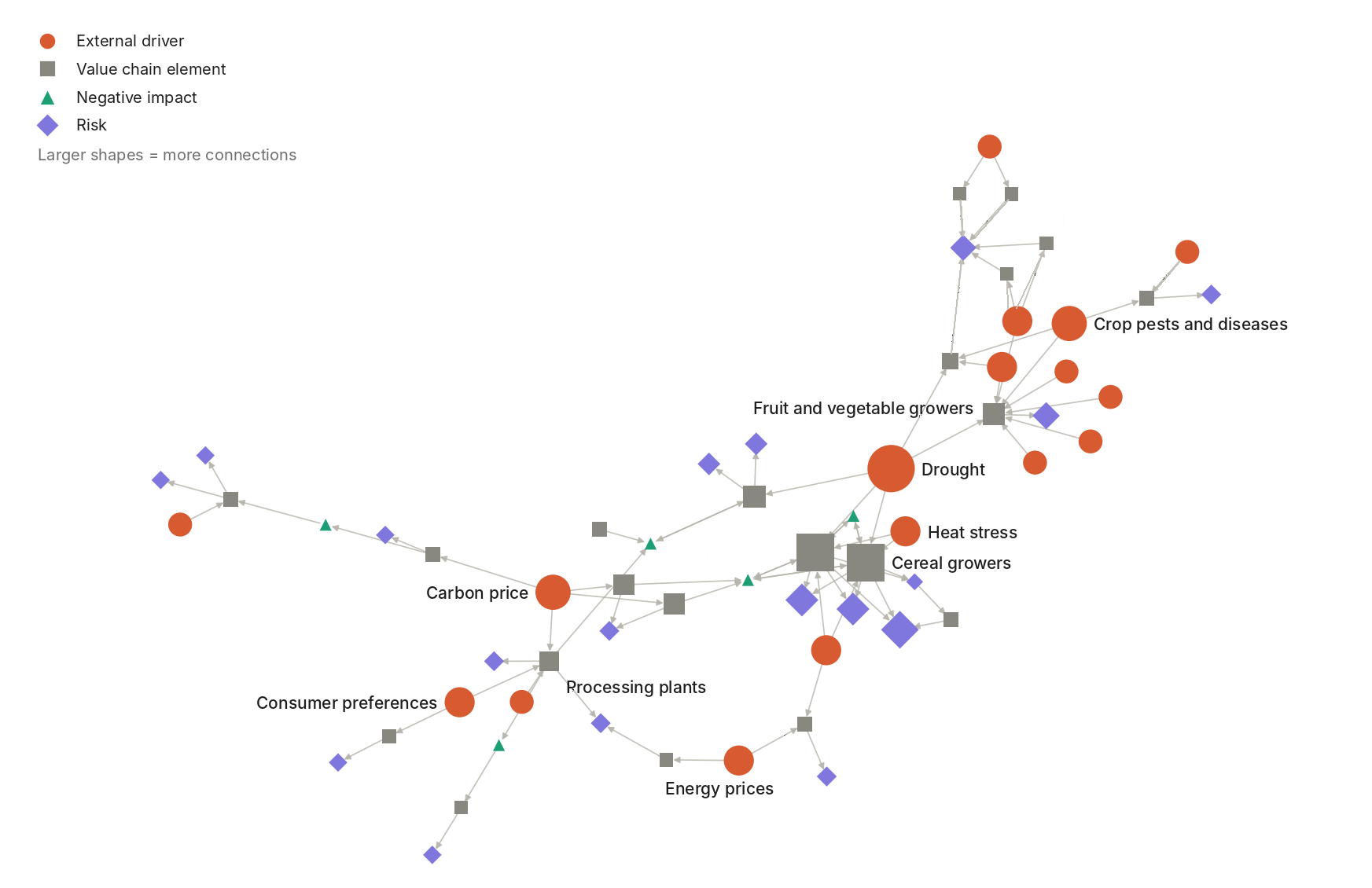
Drought is the driver most widely shared across the sector. It reaches four of the five companies, mainly through the growers of their main crop (cereal). Since competitors source from the same regions, changing supplier offers limited protection.
In four of the five companies, the growers of the main crop are the point through which most risk passes. Programmes with these growers on water, soil and contract terms would interrupt more chains than any other single intervention.
Only 9 of 61 disclosed negative impacts are linked to a financial risk for the company. Where the link exists, the same policy reduces both the impact and the risk, which strengthens the business case for acting.
35 of 82 chains start from generic statements such as “the effects of climate change”, with no hazard, region or mechanism named. These risks are difficult to prioritise and impossible to compare across companies.
From public reports to company decisions
The analysis helps guide the eye. It shows where risks share a common source and which points in the value chain carry most of the exposure, so that management attention and budgets go where they reduce the diffusion of risks. This avoids spreading resources across separate actions that address the same underlying problem, or across risks that never reach the business.
The pilot presented in this article relies on public data only. Applied with a company’s internal information (sourcing locations, supplier shares, internal risk scores), the analysis becomes more precise and produces a ranked list of interventions. The results can feed into the double materiality assessment, the climate resilience analysis and sourcing strategy, and allow a company to compare its exposure with that of its peers.
The approach is now being extended to other sectors.
Want to know how exposed your value chain is?
Synestia offers a systemic risk assessment based on your company’s reports and internal data. It shows which drivers matter most for your business, where your value chain is most vulnerable, how your exposure compares with that of your peers, and which actions reduce the most risk for the budget available.